

The next frontier of sales performance may have less to do with what reps say on the call and more to do with the state they’re in before the call starts. That sounds soft until you watch an elite athlete prepare. Then it starts to look obvious.
Athletes don’t walk into competition cold. They have warmups, rituals, visualization, recovery protocols, sleep discipline, breathwork, and coaches who understand that performance is physical, mental, and emotional at the same time. Sales leaders usually treat performance differently. We obsess over the script, the talk track, the discovery framework, the MEDDICC fields, the dashboard, the comp plan, the forecast call, the sequence, and the enablement deck. All of that matters. But the rep’s nervous system is still in the room.
If someone is anxious, depleted, or quietly spiraling after 3 bad calls in a row, the best playbook in the world won’t save them.
That was the core of my second conversation with Kevin Bailey, CEO of Dreamfuel. The first time Kevin came on the podcast, we talked about mental performance at the individual level: how leaders regulate themselves, how physiology affects judgment, and how breathwork, sleep, gratitude, and recovery shape decision quality. This episode was the next layer: how do you cascade mental performance through a team without turning into the weird wellness boss?
That’s the tension. Revenue leaders shouldn’t try to own people’s personal lives. We do not get to mandate meditation, sleep routines, gratitude journals, or weekend recovery protocols. But we also can’t pretend performance only happens inside Salesforce. The practical answer is to treat mental performance like sales infrastructure: opt-in, leader-led, connected to moments that matter, and measured by whether it helps people perform under pressure.
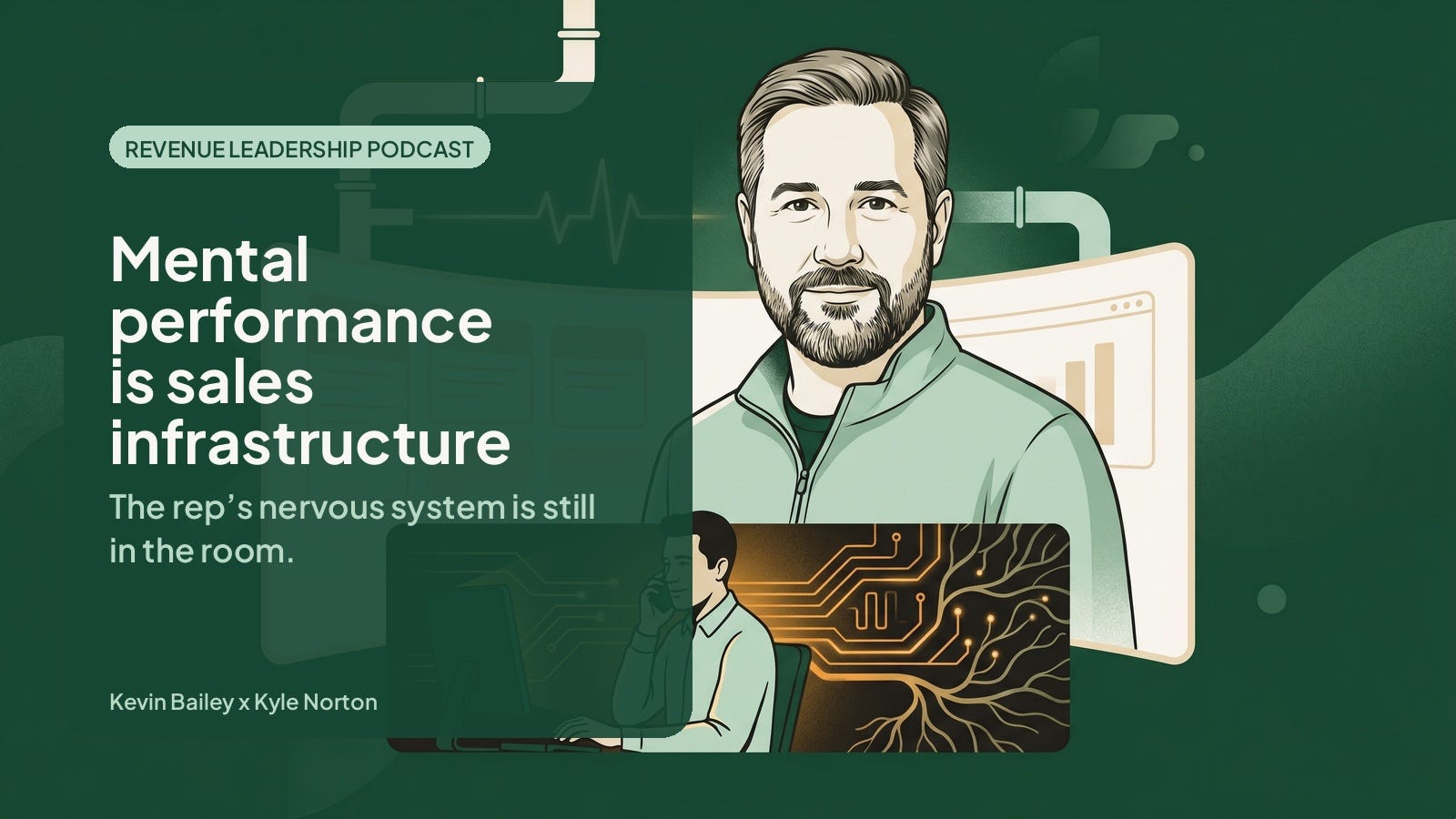
Mental performance starts with the leader
Kevin said something early that stuck with me:
“This isn’t something you just deploy on a team. Like, cool, you guys do this. I’m going to do my thing. If the leader gets jazzed about it and gets really involved, the team will follow.”
That’s the first principle. Mental performance can’t be delegated to Enablement. It can’t be buried inside a wellness benefit. And it definitely can’t show up as a random Slack message from a leader who clearly doesn’t practice any of it. The leader has to embody it first.
That doesn’t mean you need to become a monk. It means the team has to see you taking performance seriously beyond effort and hours. Do you talk openly about your pre-meeting prep? Do you protect sleep before high-stakes days? Do you reset after hard moments, or do you just spray your stress across the org? Do you model recovery, or do you quietly reward burnout while claiming you care about sustainability?
Teams are very good at detecting hypocrisy. Especially sales teams. If the CRO says, “Hey, nervous system regulation matters,” then acts like a lunatic every forecast call, the lesson is clear. The words don’t matter. The behavior does.
This is why mental performance starts as a leadership practice before it becomes a team practice. There’s good research behind this broader idea. Gallup’s work on managers has consistently shown that managers account for a huge share of variance in team engagement. Their framing, habits, and attention become the emotional weather system for the team. If the leader is reactive, the team becomes reactive. If the leader is grounded, the team has a shot at being grounded.
My takeaway: don’t roll this out. Live it first. Then invite people in.
Start with A players and frontline managers
The second mistake is trying to force mental performance on everyone at once. Kevin’s advice was the opposite: start with the people most likely to care.
Your A players are usually already hunting for an edge. They’re the ones tweaking their calendar, studying calls, changing routines, testing new prep patterns, and trying to squeeze another 5-10% out of themselves. That makes them the natural early adopters. Not because they need fixing. Because they’re already bought into improvement.
Then go to frontline managers. This part really resonated with me because I believe frontline sales management is one of the most critical jobs in a revenue org. You’re close enough to the reps to absorb the emotion. You’re close enough to leadership to absorb the pressure. You’re accountable for outcomes you don’t fully control. You jump into deals, coach people, inspect pipeline, handle escalations, translate strategy, manage activity, and somehow you’re supposed to stay calm while everyone above and below you wants something.
If you want mental performance to cascade through a sales team, frontline managers are the leverage point. Kevin put it simply: work directly with the managers, get them to embrace the tools, and they’ll start performance-coaching their teams.
That’s the right deployment path:
Leader embodies it.
A players validate it.
Managers operationalize it.
The broader team adopts what actually works.
This also avoids the biggest cultural trap: making mental performance feel mandatory. You don’t need to convince every skeptic on day 1. You need to create a few visible wins with credible people. Sales teams copy what works.
The pre-call warmup is the practical wedge
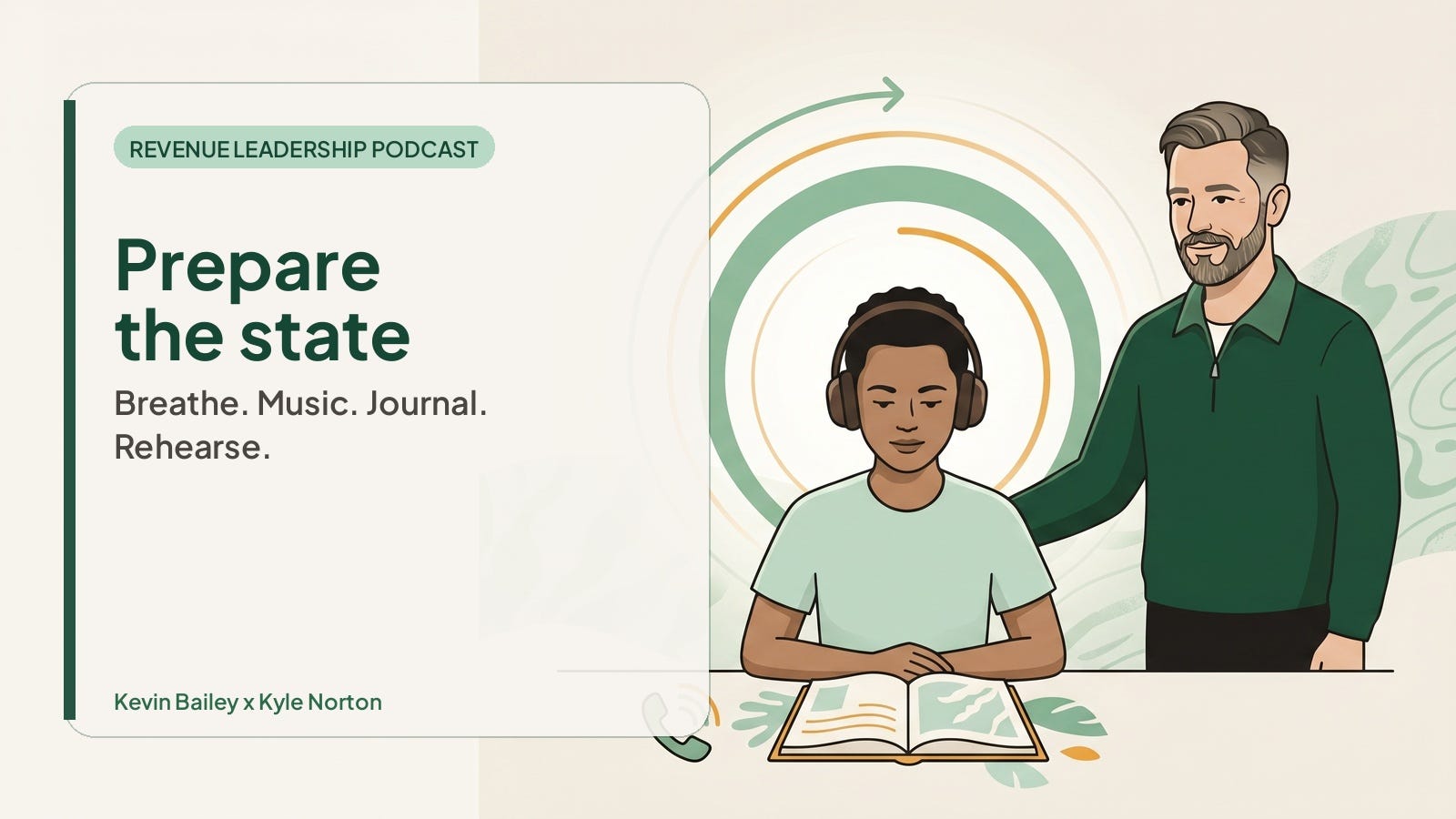
The most useful part of the conversation was Kevin’s pre-call warmup. This is where the whole thing stops sounding abstract. Kevin’s point was simple: if you can help a rep, manager, founder, or executive show up better in the moments that drive revenue, the practice becomes self-evident. His pre-call warmup has 4 parts:
Get centered with breathwork (specifics in the episode).
Put on music that fires you up.
Journal the call as if it already happened.
Rehearse the hard behaviors that made it successful.
The breathwork piece is fast. Kevin described taking 30 deep belly breaths, about a second between each breath, then holding on the 30th breath until you feel the need to breathe. His goal is efficiency: shift state quickly.
Then the journaling piece is where it gets interesting. You write the call as if it already happened. The customer leaned in. The objection came up. You handled it well. The room shifted. The follow-up was clear. The outcome happened. But Kevin made a critical distinction: the useful version is not “imagine the win and wait for the universe to deliver it.” That’s the cheap version. The useful version is using the energy from the imagined win to reinforce the hard behaviors required to earn it.
Kevin said:
“Don’t just visualize the win. Use the juice from the win to reinforce all the elite behaviors that you need to do to win.”
That’s a piece that I hadn’t considered before.
This matches what performance psychology has found for a long time. Mental practice is not magic, but it works. A 24-year follow-up meta-analysis on mental practice found that mental rehearsal produces a small but reliable performance improvement compared with no practice, especially when it’s structured and tied to specific tasks. A Frontiers review on motor imagery also found that imagined practice can support performance gains, particularly when the imagined task is complex and paired with rest or consolidation.
Sales calls are not athletic events, but the performance pattern is similar. You have stakes, pressure, timing, objections, emotional regulation, and moments where your body wants to rush, defend, over-talk, discount, or avoid the hard question. That is exactly where rehearsal helps. The best reps don’t just know what to say. They prepare the state they want to be in when it’s time to say it.
That’s the wedge I’d use with any sales team. Don’t start with a 60-minute seminar on neuroscience. Start with one big call. Have the rep do the warmup. Then inspect the difference.
Recognition is dopamine management
The most useful team-level idea was Kevin’s framing of recognition. He described dopamine as a motivation molecule. Progress, recognition, achievement, and momentum all feed the system.
In good markets, teams often get dopamine for free. The company is growing. People are getting promoted. Deals are closing. Customers are saying yes. Investors are excited. The press is writing stories. The leaderboard feels alive.
Then the market gets harder. Win rates drop. Sales cycles stretch. Budgets freeze. Good reps miss. The same effort produces fewer rewards. That’s when teams start to wobble.
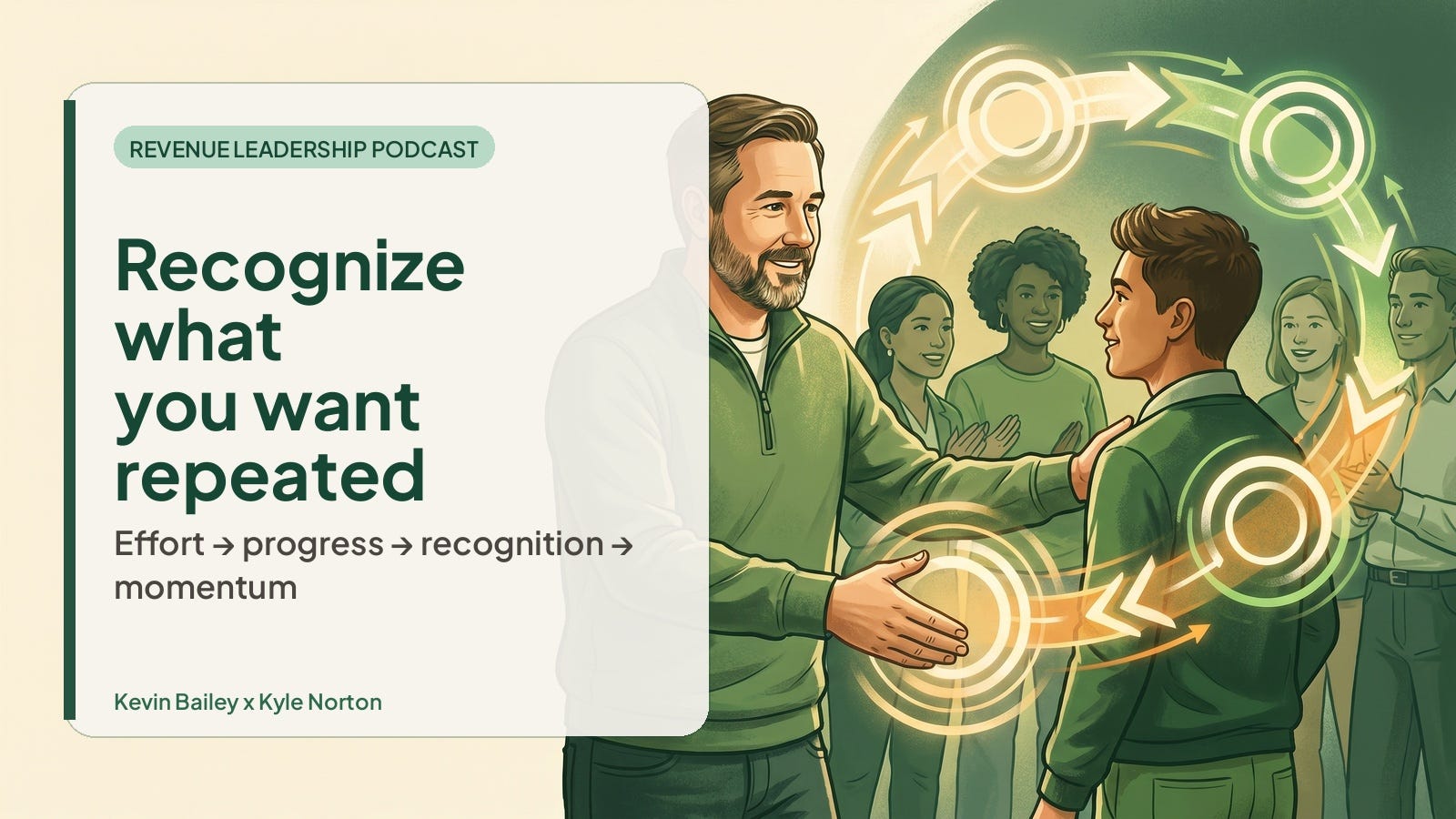
Kevin’s point was that leaders need to learn how to pulse dopamine through the system even when the scoreboard isn’t cooperating. One of the best ways to do that is recognition. But not lazy recognition. Not “congrats to Sarah for being number 1 again,” every Friday until everyone else tunes out.
You should celebrate outcomes. Winning matters. But if you only recognize outcomes, you build a fragile team. Sales has too much luck for that: good patch, bad patch, bluebird deal, champion leaves, legal delay, budget pullback, competitor faceplants, procurement surprise, two deals slip for reasons nobody could control. If the only thing you recognize is the final number, your culture becomes emotionally hostage to variance.
Kevin’s recommendation was to recognize effort effectively.
“If you can effectively recognize effort within a team, you pulse the team dopamine iteratively, even during moments where they’re not naturally getting it.”
That is a very practical leadership idea. Recognize the rep who ran the best discovery process, even if the deal didn’t close yet. Recognize the manager who helped a struggling rep recover confidence. Recognize the person who changed a behavior they’ve been working on for 30 days. Recognize the best objection handling of the week. Recognize a personal best. Recognize the input you want repeated.
Gallup and Workhuman have found that recognition is strongly tied to engagement and performance. One Gallup/Workhuman report found that employees who rate recognition highly are much more likely to be engaged, and that stronger recognition is linked to productivity, retention, and reduced burnout. Gallup has also reported that only about 1 in 3 U.S. workers say they received praise or recognition in the last week.
That’s wild. Recognition is one of the cheapest performance tools leaders have, and most teams still underuse it. The point is not to become a cheerleader. The point is to manage energy deliberately. Recognize what you want repeated.
Executives need serotonin days
The most uncomfortable idea in the episode was Kevin’s “serotonin day.” He tells leaders they need 1 serotonin day every 2 weeks: a full day without striving. No Slack. No goals. No phone dopamine loop. No achievement agenda hiding inside a “recovery” activity. You know I’m sick because that sounds like a nightmare to me.
Kevin used a great analogy: a kid kicking a soccer ball for the joy of it is serotonin. Turn it into a scored game with a clock, and now you’re back in dopamine. That hit me because if you’re wired like most executives, you can turn anything into a performance activity. Workout? Track it. Walk? Optimize the route. Reading? Take notes for content. Family time? Squeeze it between calls. Vacation? Clear Slack in the bathroom. Even recovery becomes another scoreboard.
Kevin’s argument is that high performers can’t run on dopamine, noradrenaline, and cortisol forever. You need a real reset. Not because rest is morally good. Because judgment quality matters.
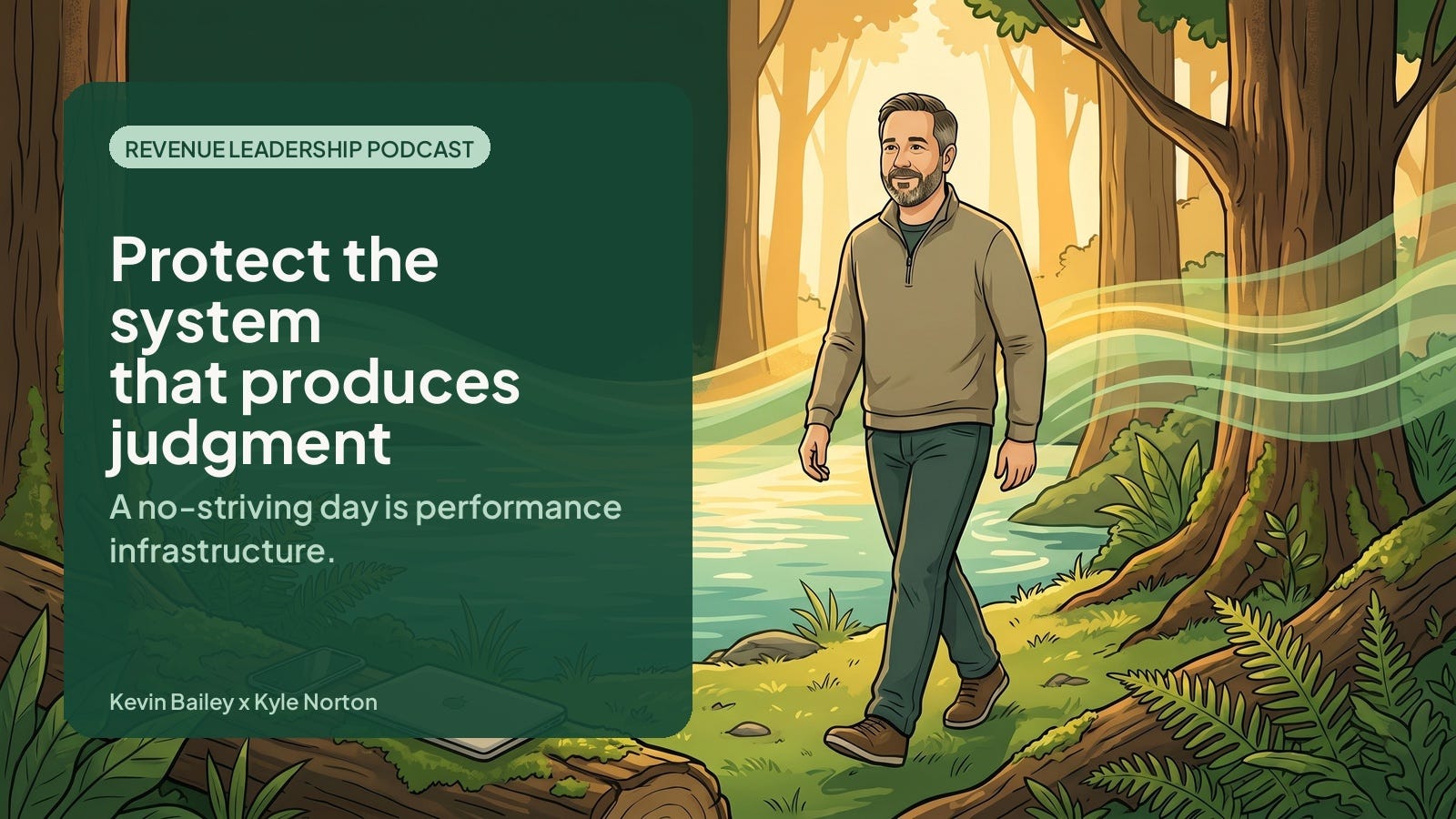
There’s a strong research base around this broader idea. Attention Restoration Theory, developed by Rachel and Stephen Kaplan, argues that certain environments help restore directed attention. More recent research has continued to test this. A 2024 Scientific Reports study found that a 40-minute nature walk improved neural markers related to executive attention compared with an urban walk. A newer meta-analysis found that nature exposure tends to produce small but real cognitive restoration benefits, especially for working memory and attentional control.
You don’t need to call it a serotonin day if that language feels too precious. Call it a no-striving day. Call it a nervous system reset. Call it a day where you stop extracting utility from every waking minute. The point is the same: if your job depends on judgment, you have to protect the system that produces judgment.
That means recovery is not separate from performance. It’s part of the operating model.
The sales team is not a spreadsheet
The mistake revenue leaders make is thinking the “real” system is the CRM, the forecast, the process, the methodology, and the manager cadence. Those are real. But they sit on top of a human performance system.
A rep in threat state hears the objection differently. A manager running on cortisol coaches differently. A CRO who hasn’t recovered makes different calls. A team with no recognition loses energy before it loses skill. A seller who rehearses the hard moments before the call has a better chance of executing when pressure hits.
That is the real argument from this episode. Mental performance is not a side quest. It is sales infrastructure.
Start small. Pick one manager. Pick one A player. Pick one big call. Run the pre-call warmup. Recognize the behaviors you want repeated. Protect one real recovery block. Then watch what changes.
Because the next unlock in your sales team may not be another field in Salesforce. It might be the state your team is in when the moment arrives.
Listen to the full episode:
Research referenced:
What I find particularly valuable in this perspective is the distinction between rewarding results and recognizing the behaviors that make results repeatable.
This becomes even more relevant in IVD sales, where complex buying processes, multiple stakeholders, tenders and long decision cycles can separate good commercial execution from revenue by several months. If leaders recognize only closed deals, they risk rewarding outcomes without understanding how they were achieved, while overlooking the behaviors that actually build a healthy pipeline.
I would add one nuance to the idea of “manufacturing motivation.” A CSO cannot directly manage motivation, which is inherently personal and variable. What leadership can manage are the conditions that make the right commercial behaviors more likely: better discovery, disciplined stakeholder mapping, fact-based deal reviews, coaching after losses, thoughtful objection handling, and the willingness to walk away from poorly qualified opportunities.
Revenue remains the outcome. But the behaviors that produce predictable revenue are what a sales organization can observe, coach and replicate.
For me, that is where sales leadership makes the difference: not keeping people permanently motivated, but building an environment in which they know how to perform even when motivation inevitably fluctuates.