

AI can now research your prospect, write your email, take your call notes, fill your CRM, and draft your follow-up. It can do basically everything a salesperson does in a day. And somehow, that makes human salespeople more valuable, not less.
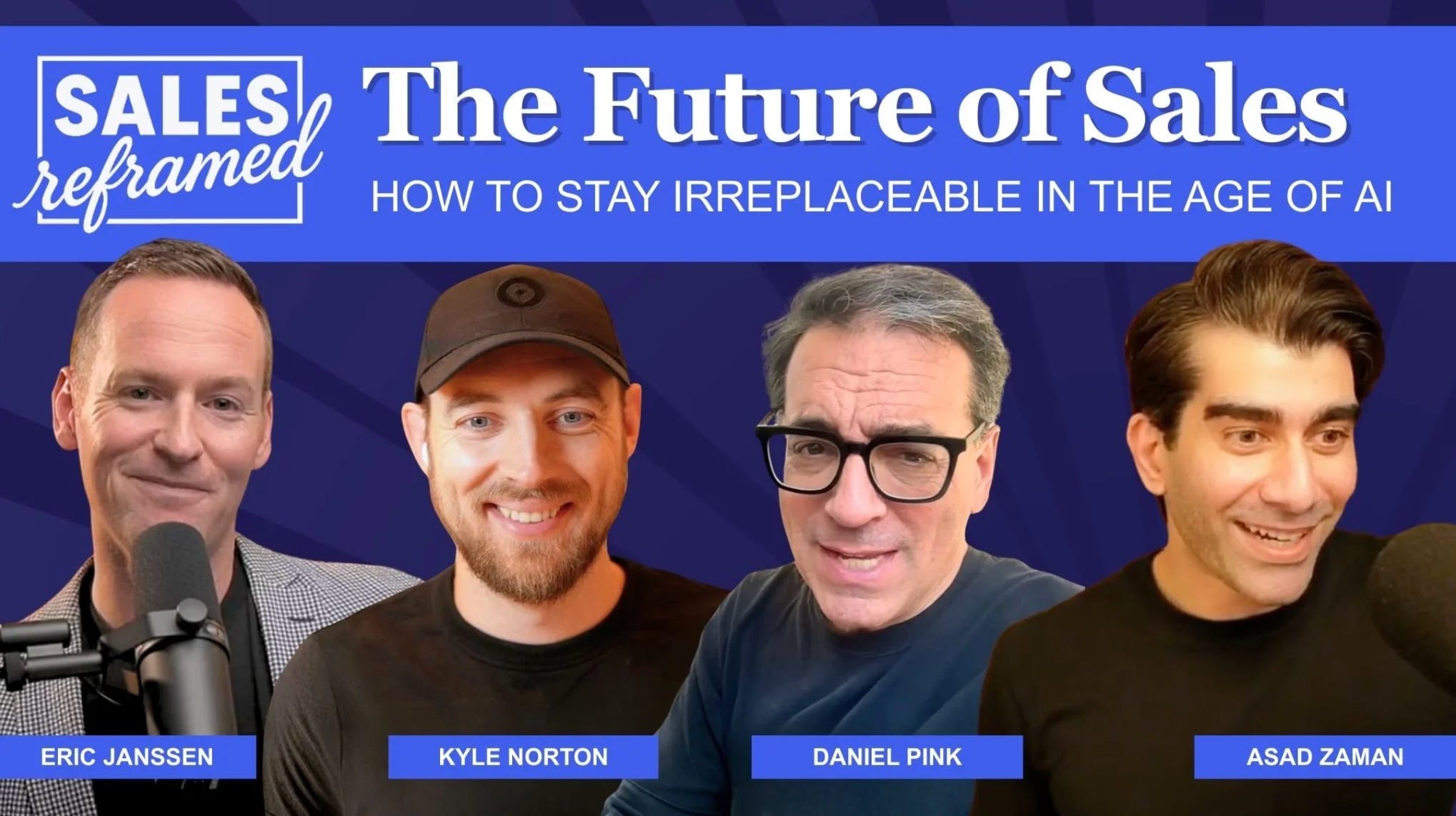
Eric Janssen put that question to me, Daniel Pink, and Asad Zaman in separate interviews for the same episode of Sales Reframed. The fact that we all landed in the same place is worth paying attention to.
For context: Eric is an entrepreneur turned sales professor at Ivey Business School. He’s built Sales Reframed around this idea that sales is a life skill, not just a job function. For the final episode of the season, he wanted to tackle the future of sales head-on, so he talked to three people coming at it from very different angles. Daniel Pink wrote the literal book on modern selling (To Sell Is Human). Asad Zaman is the CEO of Sales Talent Agency and has spent 15+ years matching sales talent with companies. And I’m in the weeds every day as CRO at Owner.com, building an AI-native sales org approaching $100M ARR.
We recorded separately. None of us heard each other’s answers. And yet the throughline was almost identical: AI is changing the homework of sales, not the hard work. The research, the data entry, the note-taking, the follow-up drafting. All of that is getting automated. But the judgment calls, the relationship building, the ability to read a room and adapt in real time? That’s getting more valuable by the day.
Here’s what stuck with me from the full conversation.
“Where Do I Start?” Is the Wrong Question
Every conference I speak at, someone asks me: “Where should I start with AI?” They want me to say “AI SDR” or “AI forecasting” or “conversational intelligence.” A specific tool they can buy, implement, and check a box.
But that framing assumes AI adoption is linear. Step one, step two, step three, done. In reality, the transformation is organic and recursive. There are feedback loops. What you learn from structuring your call data changes how you think about prospecting, which changes how you train reps, which changes what data you collect. It compounds.
So I’ve started reframing the question entirely. Stop asking “where do I start?” and start asking “how do I transform my company to be AI native?” One implies a project with an end date. The other implies a permanent shift in how you operate.
The answer starts with data foundations. Nothing else works until you have good first-party and third-party data. AI is a data model. Feed it garbage and you get garbage back, just faster. At Owner.com, we use Momentum to take unstructured call transcripts and pull out structured insights: what competitors did the prospect mention? What’s their current tech stack? What POS platform are they on? That information flows straight into Salesforce fields. Now every subsequent tool in the stack has something real to work with.
McKinsey’s 2025 State of AI report found that 78% of organizations now use AI in at least one business function, up from 55% just a year prior. But adoption and value creation are different things. Gartner’s research predicts that by 2028, AI agents will outnumber sellers by 10x, yet fewer than 40% of sellers will report that those agents actually improved their productivity. The gap between “using AI” and “getting value from AI” is almost entirely a data and transformation problem.
The other piece nobody wants to hear: this falls on the leader. You can’t outsource your AI strategy to McKinsey and expect it to hold up for more than six months. The technology moves too fast. Your leadership team needs to build real fluency, not just approve a vendor contract. Consultants can fill capability gaps, but only inside a vision you actually own and understand.
The Homework and the Hard Work
Eric Janssen used a framing during the episode that I keep coming back to. He broke the sales process into two categories: homework and hard work.
Homework is the research, the data scraping, the note-taking, the CRM updates, the follow-up email drafting. All the stuff that used to eat 60% of a rep’s day and had nothing to do with actually selling. AI is eating that whole category alive, and it should.
Hard work is judgment. Reading a room. Building trust over a 9-month enterprise deal cycle. Knowing when to push and when to back off. Deciding that the deal on paper looks great but something feels off about the champion’s commitment level. That category is getting more valuable, not less.
Here’s where it gets interesting. Daniel Pink made a point during his segment about information parity that connects directly. For basically all of human civilization until about 15 years ago, sellers had more information than buyers. That asymmetry is what made the sleazy salesperson possible. Now buyers have as much information as sellers, tons of choices, and every platform in the world to talk back on. Pink calls it the shift from “buyer beware” to “seller beware.”
In that world, the homework matters less because buyers are doing their own homework anyway. A 2025 G2 survey found that half of B2B software buyers now start their buying journey in an AI chatbot instead of a Google search. That number jumped 71% in just four months. Your buyers are walking into calls pre-researched. They’ve already asked Claude or ChatGPT about your product, your competitors, and your pricing.
So the hard work, the human work, becomes the entire ballgame. Can you add perspective they didn’t find in a chatbot? Can you connect their problem to a solution they hadn’t considered? Can you build enough trust that they choose you over the five other vendors whose features look identical on paper?
The Expertise Filter
Asad Zaman brought up a study during his segment that I think deserves way more attention than it’s getting. Researchers gave generative AI tools to material science researchers at a major lab. For the top third of researchers, AI doubled their productivity. For the bottom third? It did basically nothing.
The difference was expertise. The best researchers had the taste, judgment, and pattern recognition to know which AI-generated suggestions were good and which were garbage. They used AI as an accelerant for instincts they’d already developed. The weaker researchers couldn’t filter signal from noise because they didn’t have the signal in the first place.
This maps directly to what I see in sales orgs every day. Give your best AE an AI research tool and they’ll pull insights that completely reshape their discovery calls. Give that same tool to a rep who doesn’t understand the buyer’s world, and they’ll just copy-paste whatever the model spits out. Same tool, wildly different outcomes.
Gartner’s data backs this up: sellers who effectively partner with AI are 3.7x more likely to hit quota than those who don’t. But Gartner also predicts that by 2028, fewer than 40% of sellers will report AI agents actually improved their productivity. The gap is expertise. AI is a multiplier, and multiplying zero still gives you zero.
This is why I push so hard on universities leaning into AI rather than restricting it. Your employer doesn’t care if ChatGPT or Claude cowrote that email. They want great work product. If schools are teaching students to avoid AI, they’re training them for a world that doesn’t exist anymore. Day one that somebody starts with me, I’m not criticizing their use of AI. If anything, I’m wondering why they’re not using it more.
The SDR Isn’t Dead. The Lazy SDR Is.
One of the most discussed questions in revenue leadership right now is whether AI kills the SDR/BDR role. Asad had a surprisingly grounded take on this. He actually went and talked to the founders building AI SDR products. Their answer was more honest than you’d expect from people selling the replacement.
Here’s the thing nobody talks about: the FCC ruled in February 2024 that AI-generated voice calls fall under the TCPA. That means AI can’t cold call someone who hasn’t given prior express consent. And even when there is consent, the AI has to disclose upfront that it’s artificial. As Asad put it, “Hi, I’m cold calling you from X company, and I am AI.” What happens? Everyone hangs up.
So the AI SDR becomes a copilot, not a replacement. The emailing component gets faster, higher volume, better targeted. But someone still has to pick up the phone. Someone still has to multithread into an account. Someone still has to read the room when a prospect gives a half-interested “maybe” and figure out what’s actually behind it.
Asad’s team is proving this in real time. While most outreach has devolved into short, vague, mass-blasted garbage, Sales Talent Agency went the opposite direction: long-form, deeply personalized messages where every word shows they did the work. The result? 60-70% response rates on LinkedIn InMails, in a world where most recruiters and sellers celebrate 15%. Some responses were people saying “this is the best message I’ve ever received from a recruiter.”
That’s the playbook. When everyone zigs toward automation and volume, you zag toward depth and personalization. AI handles the research that makes depth possible. The human delivers it.
Upheaval, Not Apocalypse
Daniel Pink made a point during his interview that I keep thinking about. He’s old enough to remember when people said Google would destroy every sales function because buyers could find anything themselves. Before that, spreadsheets were supposed to replace accountants. He brought up James Bessen’s famous research on ATMs and bank tellers: between 1988 and 2004, ATMs cut the number of tellers per branch from 20 to 13. But that efficiency made branches cheaper to operate, so banks opened 43% more of them. Total teller employment actually grew.
The job didn’t disappear. It transformed. Tellers went from counting cash to relationship banking, selling high-margin financial products. The routine work got automated. The human work got more valuable.
Pink sees the same pattern with AI and sales. His framework from To Sell Is Human holds up remarkably well 13 years later. The old ABCs of selling were “Always Be Closing.” Pink’s version is Attunement (can you see the world from your buyer’s perspective?), Buoyancy (can you stay afloat in an ocean of rejection?), and Clarity (can you surface problems your buyer hasn’t identified yet?). AI can help with all three. It can prep you to be more attuned, give you data to maintain buoyancy when the pipeline looks thin, and surface patterns that sharpen your clarity. But it can’t replace any of them.
Pink’s word for what’s happening is “upheaval,” and I think that’s exactly right. Not apocalypse. Upheaval. The job changes shape. Some roles shrink. New ones emerge. But the core of what makes a great salesperson, the taste and judgment and ability to connect with another human being, that’s not going anywhere.
There’s a useful caveat to the ATM story, though. After 2010, mobile banking finally did what ATMs never could. Teller employment dropped 50% in twelve years because mobile didn’t just automate tasks within the existing system, it created an entirely new paradigm that made branches less necessary. The lesson: partial automation transforms jobs, but paradigm shifts can eliminate them. We’re in the partial automation phase of AI in sales right now. Whether it stays there is something none of us can predict.
What This Means for You
The three of us came at this question from completely different angles. I’m running a sales org in the middle of this transformation every day. Asad is watching the talent market shift in real time. Daniel has spent a decade studying the underlying psychology of why humans buy from humans.
We all landed in the same place: the future belongs to practitioners who use AI to do better human work, not to replace it.
If you’re a revenue leader, the move is straightforward. Fix your data foundations. Build AI fluency on your leadership team instead of outsourcing it. Push your reps to use AI constantly, not as a crutch but as a research engine that raises the bar on every interaction. And invest in the hard work skills that no model can replicate: reading a room, building trust over time, and having the judgment to know when the data says one thing but your gut says another.
If you’re early in your career, the message is even simpler. Become the person whose expertise makes AI useful. Build the filter. The reps who treat AI like a magic email writer will wash out. The ones who use it to walk into every call sharper, more prepared, and more curious than the person on the other end of the line expected? Those are the people I want to hire.
The episode is worth a listen. Eric Janssen did a great job weaving together three very different perspectives into something cohesive. Check out Sales Reframed wherever you get your podcasts.
Great podcast and article!
Really enjoyed reading this. The "homework vs hard work" framing is such a good way to think about the shift. Also, couldn't agree more that "someone still has to pick up the phone" when it comes to SDRs and AI. Thanks for sharing Kyle!